Old Deck & Patio Teardowns: What It Takes to Clear Weather-Damaged Outdoor Structures
Tearing down an old, weather-damaged deck or patio requires structural planning, specialized demolition equipment, and careful disconnection of ledger boards to prevent home siding damage. While a DIY teardown takes days and carries severe rusty nail and collapse risks, hiring a licensed service like Junk It Off delivers complete structure dismantling, concrete footer handling, legal pressure-treated wood disposal, and a clean magnetic nail sweep in hours.
5 Red Flags That Mean Your Deck Must Come Down Immediately
Wooden outdoor structures have a finite lifespan. Once the protective sealants fail and moisture infiltrates the framing, the structure becomes a severe liability. If you notice any of the following signs, the deck is beyond cosmetic repair and requires total demolition:
- Spongy Wood and Extensive Dry Rot: Soft, crumbling wood along the main load-bearing joists indicates total structural failure.
- Railing Sway and Post Detachment: If your railings wobble or fail a basic lateral load test, the carriage bolts have rusted through or the wood holding them has rotted away.
- Failing Ledger Connections: The ledger board attaches the deck to your house. Rusted lag screws, missing flashing, or corroded joist hangers here mean the deck is at imminent risk of detaching and collapsing.
- Severe Pest Infestation: Deep structural burrowing and sawdust piles from termites or carpenter ants permanently compromise the integrity of 4×4 posts and joists.
- Sinking or Shifting Concrete Piers: Frost heave, soil erosion, or tree root intrusion can crack ground-level patio slabs and heave concrete footers, twisting the deck frame out of level.
Step-by-Step Anatomy of a Safe Deck Demolition
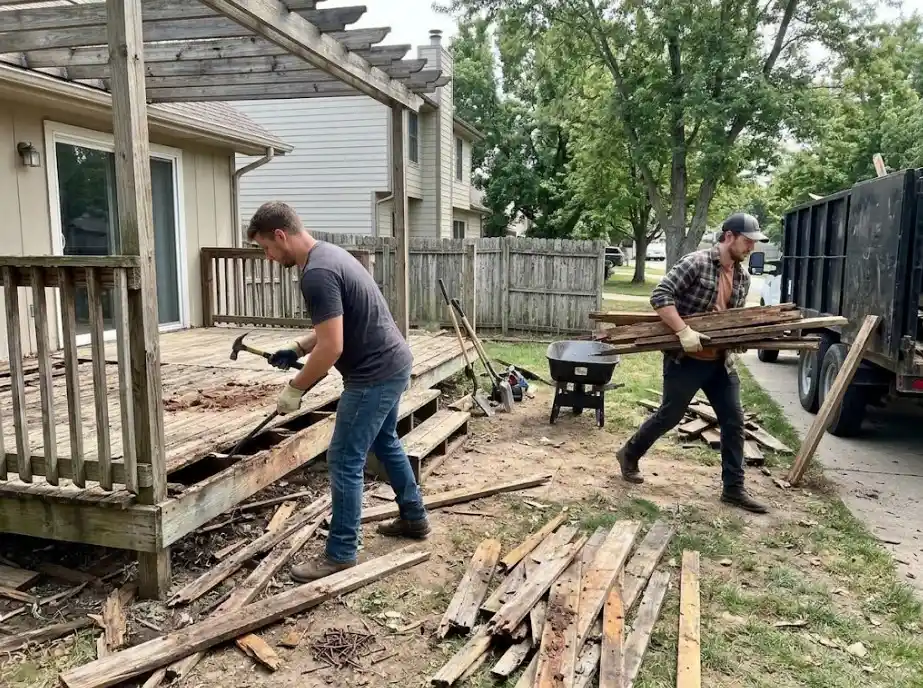
Tearing down a deck is not about wildly swinging a sledgehammer; it is a systematic, top-down deconstruction process designed to protect the primary residential structure and the property grounds.
Step 1: Utility & Site Clearance Before any tools are mobilized, the site must be cleared. This includes removing patio furniture, securing pets and children indoors, and verifying that no buried sprinkler lines, gas pipes, or electrical conduits are running immediately beneath or attached to the deck structure.
Step 2: Top-Down Disassembly Demolition starts at the highest points. Crews use reciprocating saws (Sawzalls with carbide-tipped demolition blades) and heavy pry bars to remove handrails, balusters, and perimeter stairs first. This prevents top-heavy sections from collapsing unexpectedly onto workers.
Step 3: Deck Board Stripping Once the rails are down, the surface decking is stripped. Using commercial demo forks and heavy pry bars, technicians lever up the deck boards from the joists. Rusted screws that strip out are cut flush with reciprocal saws to speed up the extraction process.
Step 4: Framing & Ledger Disconnection This is the most critical and hazardous phase. The ledger board must be disconnected from the home’s exterior wall. A professional crew will support the remaining joists, make strategic relief cuts, and carefully back out the structural lag screws or thru-bolts. Doing this incorrectly rips away exterior siding, breaks stucco, damages house band joists, and leaves the home vulnerable to water intrusion.
Step 5: Post & Concrete Footer Resolution Old decks rest on deep concrete footers (often weighing 100–300+ lbs each) or sonotube piers. Depending on your future landscaping plans, crews will either extract the piers completely using jacks and heavy machinery, or cut the wooden support posts below grade (6–12 inches underground) and backfill the holes with clean soil to prevent lawnmower blade strikes.
Step 6: The Magnetic Safety Sweep Weathered decks contain thousands of corroded 3-inch deck screws, ring-shank nails, and rusted metal brackets. Once the heavy debris is loaded into the hauling trucks, Junk It Off conducts a mandatory magnetic roller sweep across all turf, soil, and gravel pathways to clear hidden puncture hazards that could injure pets or children.
DIY Deck Demolition vs. Professional Removal Matrix
| Feature / Task | DIY Approach with Dumpster Rental | Junk It Off Full-Service Teardown |
| Heavy Equipment & Tool Investment | Requires purchasing/renting demo forks, carbide saw blades, and heavy pry bars. | Fully equipped with commercial demolition gear upon arrival. |
| Physical Labor & Time Required | Often takes homeowners multiple weekends of back-breaking labor. | Completed safely in a matter of hours. |
| Siding & Property Damage Liability | High risk of ripping off stucco or house siding during ledger removal. | Fully insured; expert ledger disconnection protects the house envelope. |
| Pressure-Treated Wood Disposal | Homeowner must manually load dumpster and ensure the transfer station accepts treated wood. | Handled completely by the crew according to local environmental regulations. |
| Yard Cleanup & Nail Safety | Rusted nails are easily lost in the grass, causing future hazards. | Comprehensive sweep-clean service includes a mandatory magnetic nail sweep. |
Environmental & Legal Realities of Outdoor Wood Disposal
Disposing of an old wooden deck is heavily regulated. You cannot simply leave construction lumber on the curb for municipal trash pickup, and you absolutely cannot burn it.
Older decks (built prior to 2004) were commonly treated with Chromated Copper Arsenate (CCA), while newer decks utilize Alkaline Copper Quaternary (ACQ). Burning these pressure-treated woods in a residential fire pit releases highly toxic chemical fumes and arsenic into the neighborhood air. Furthermore, treated wood is strictly prohibited from clean wood recycling or mulch grinders at municipal transfer stations. Junk It Off ensures that all aged, chemically treated lumber is routed exclusively to certified Class III C&D disposal facilities.
What About Old Patios? (Paver, Concrete Slab & Flagstone Clearance)
Beyond wooden decks, outdated ground-level patios present their own set of heavy logistical challenges. If your patio has become a tripping hazard, our light demolition crews are equipped to handle the heavy lifting:
- Concrete Slabs: We break up cracked or sunken concrete slabs using heavy sledge tools and rotary hammers, loading the heavy aggregate directly into our reinforced trucks.
- Pavers & Flagstone: We manually lift and extract heavy interlocking paver stones, bricks, and flagstone slabs, diverting clean masonry to aggregate recyclers whenever possible.
- Grade Leveling: Once the heavy hardscaping is removed, we clear out the underlying sand or gravel base, leaving a flat, graded dirt surface ready for new sod, stamped concrete, or a modern deck rebuild.
Frequently Asked Questions
How long does it typically take to demolish and haul away an average backyard deck?
A professional light demolition crew can typically dismantle, load, and haul away an average-sized residential backyard deck (e.g., 12×12 or 10×20) in a single day, often within just a few hours.
Can I put old deck boards and posts in my regular municipal curbside trash?
No. Municipal curbside sanitation trucks strictly prohibit bulk construction and demolition (C&D) debris, especially pressure-treated lumber. This material must be hauled to specialized, certified waste transfer stations.
Will removing a deck attached to my house damage the exterior siding or stucco?
It can if done incorrectly. The ledger board must be carefully disconnected by backing out the structural lag screws and cutting the framing away precisely. Junk It Off’s crews are trained to detach ledger boards safely to preserve your home’s siding, stucco, and flashing.
How much does it cost to have a professional demolish and remove an old deck?
Pricing is fully transparent and based on the square footage of the structure, the complexity of the teardown (e.g., height, staircases, concrete footer removal), and the total volume of debris loaded into our trucks. We provide free, upfront, no-obligation estimates prior to starting any work.
What happens to the deep concrete footers holding up the deck posts?
Depending on your preference and future backyard plans, concrete footers can either be manually excavated and hauled away, or the wooden posts can be safely cut 6 to 12 inches below the soil grade and backfilled with dirt.